
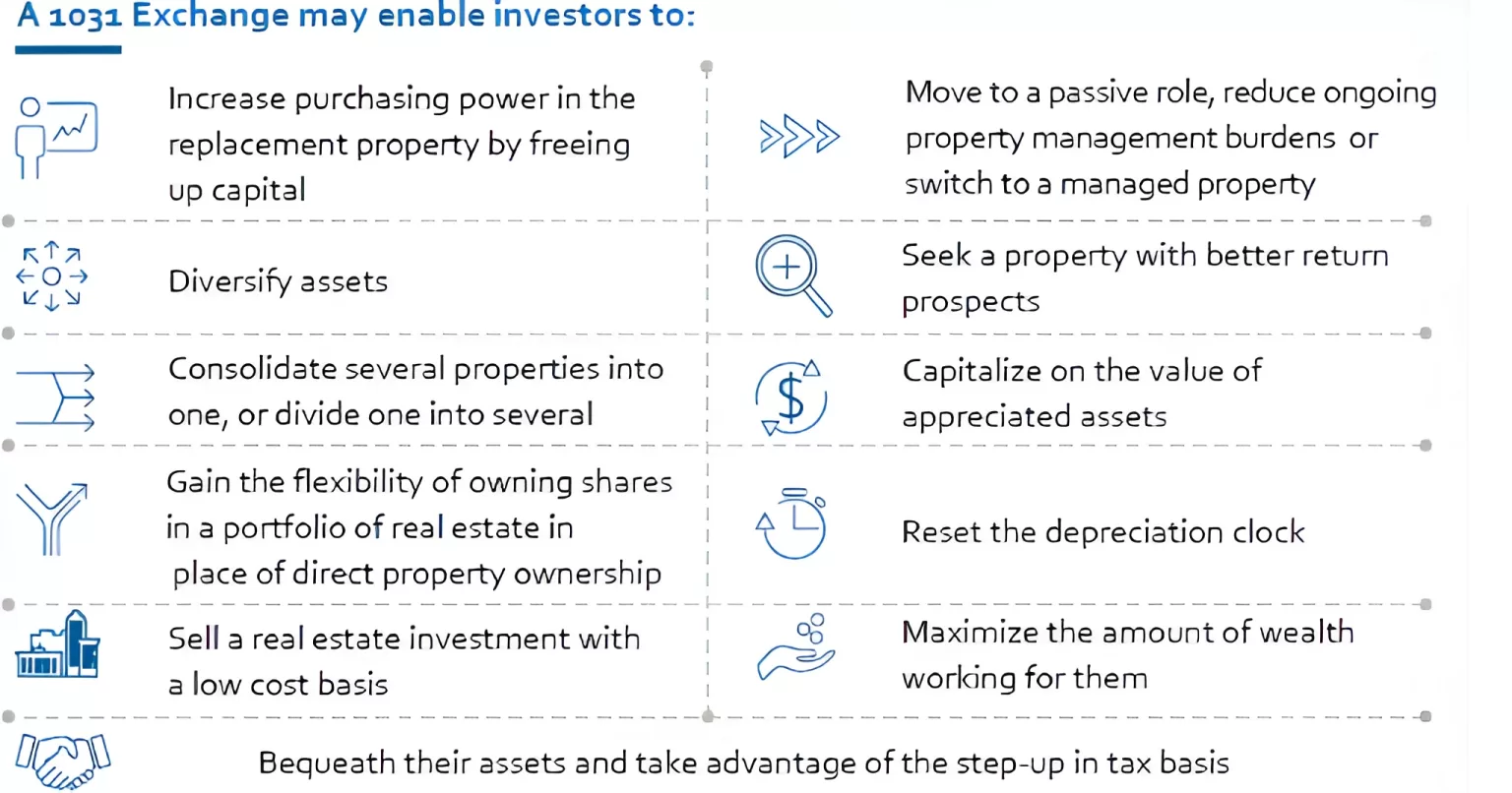
The 1031 exchange allows an exchange of one property for another without incurring any income taxes on the exchange. There may be no better tax incentive than the 1031 Exchange, available exclusively to real estate investors.
Named in reference to section 1031 of the Internal Revenue Code, the “1031 Exchange” allows an investment property owner to exchange one or more investment properties for a replacement investment properties(s), without any capital gains tax due at the sale. (See requirements and strict timelines discussed below.) This can be done a an unlimited number of times until owner eventually sells their property. Then The capital gains are realized”.
Moreover, if you keep the property until your death, and pass it to your heirs, capital gains taxes may be avoided entirely due to the current IRS applicable taxable exclusion amount for gifts and inheritance and the “step-up in basis” (dependent upon that year’s tax rules; see our blog for current updates on inheritance tax laws). This ability to sell and buy various investment real estate throughout the country with no capital gains throughout your lifetime is colorfully referred to as “swap till you drop.” California property owners should be aware of specific California rules when exchanging California with out of state property.
Investment property owners in San Francisco, Marin, Oakland, San Jose and countless other communities with explosive growth in property value can utilize this crucial tool to sell investment property(ies) in one location, and transfer 100 percent of those profits, 100 percent tax-free, into the purchase of a new property(ies) elsewhere, anywhere in the United States.
A 1031 Exchange may be beneficial to transfer the location of a real property asset (i.e. state to state, city to city) and/or the number of investment properties (i.e. one single-family home into several single-family homes, condominiums, duplex(es), or apartment complexes) and/or the type of real property (i.e. a single-family home to a commercial warehouse). This can even apply to related persons, but they must keep the property for at least two years after the exchange.
Many rules and strict timelines must be followed and professional assistance is required. Below is a brief overview of the process, some rules, and a few common examples. Your should discuss your specific issues with your real estate lawyer.
What is a 1031 Exchange and how does it work?
HOW A 1031 EXCHANGE WORKS / TAX-FREE VS. TAX-DEFERRED
The 1031 Exchange offers an alternative to selling an investment property by allowing the taxpayer to exchange it for another property of “like kind” and similar Value. The primary benecfit of a 1031 exchange is that there no capital gains taxes at the time of the transfer. Section 1031 defers, or delays, payment of capital gains taxes until the Taxpayer later sells the property he exchanged. If the subsequent property is later sold without another 1031 Exchange, then taxes will be due (absent other exceptions such as inheritance or gift tax).
It is possible to deferred capital gains for many years as . There is no limit on the number of 1031 Exchanges a property owner can perform. Thus, by usingother estate planning mechanisms (i.e. gifting and inheritance), a 1031 Exchange can be utilized to help eliminate or reduce overall estate taxation.
What are the RULES OF A 1031 EXCHANGE
In a basic 1031 exchange, the Property owner must exchange real property for another real property. The exchange should not include any other property including cash. The parties to the transaction must not receive any of the money, even for the temporary purpose of purchasing the new property. For this reason, a third party is required to assist with a 1031 Exchange (and technically take possession of the property, the money exchanged and reinvested into the new property, after which the title is transferred back to the owner).
Here are the Three key rules that apply
(1)Parties must Acquire “like-kind” Replacement Property that will be held for investment or used productively in a trade or business
“Like Kind” can apply to virtually all forms of investment real estate in the United States (residential, commercial, agricultural, etc.), with exclusions for purely development properties (i.e. you cannot purchase real estate specifically to develop or “flip” and resell the same). The intention of the incentive is to exchange real property investment assets to hold or use, not an incentive for new construction or redevelopment.
(2) Purchase Replacement Property
(a) of equal or greater value;
(b) reinvest all of the equity, and;
(c) obtain the same or greater debt on the Replacement Property.
In other words, the entire value must be replaced, not just the profits or taxes will be due on the difference (aka “boot).
“Boot” is essentially anything not rolled over and is taxable.
Debt may be replaced with additional cash, but cash equity cannot be replaced with additional debt. Thus, you cannot take cash profits and “exchange” with debt. All the cash must be rolled over.
(3) Follow the Required Timelines
- Exchange must be completed within 180 days (i.e. from the sale of the first property until closing on the purchase of the second).
- Exchange Property must be “identified” within 45 days of the sale of the first property (i.e. must inform some third party to “identify” which property you are exchanging).
This short timeline to “identify” the property means the party has little time to purchase a new property and the processes should happen simultaneously. If you sell the first property and are unable to close on a new property in time, you will owe the full taxes on the sale.
Earlier we mentioned that property other than real estate received in a 1031 exchanged would be considered to be Boot. “Boot” received in a 1031 is fully taxable upon receipt by the taxpayer.
Here is an example of a 1031 exchange.
A thirty-unit apartment complex in Oakland, purchased for $400,000 many years ago, sells today for $8 million The owner uses section 1031 to exchange that property for a San Francisco apartment complex, for $9mm. The owner will owe zero capital gains taxes on the $8 mm gain from the Oakland apartment complex.
Subsequently, the owner can pass the San Francisco Buliding to his or her heirs via gifting and/or estate planning, potentially with zero capital taxes ever due on the profit (if the total estate is under current limits, $15 million as of July 2025).
Example No. 2 – with “Boot”:
A Newport Beach bayfront estate, used as a rental and investment property, is sold for $8mm with $6mm in profits. The owner purchases a Bed & Breakfast in Maine for $6mm and keeps $2mm from the sale. The owner will owe capital gains taxes on the $2mm “boot” (i.e. the difference between the sale price of the Oakland Propertye and the purchase price of the San Francisco Proprety), but the owner will not owe any capital gains taxes on the $6mm in profits.
Thus the 1031 Exchange remains incredibly beneficial, even if all funds are not fully rolled into the new property, aka a “partial exchange”.
How are mortgages on the relinquished property treated?
A mortgage or deed of trust on the Relinquished Property can be paid off with exchange proceeds. (The Relinquished property is the property the owner wishes to exchange) The portion of the proceeds used to pay the mortgage or deed of trust are deemed Realized Proceeds, however and are included in the Exchange Value, so the mortgage must either be replaced with a new mortgage or cash in purchasing of the Replacement Property.
If the Taxpayer borrowed funds to purchase the Relinquished Property, the loan cannot be repaid out of exchange funds unless the loan was secured by a mortgage or deed of trust on the Relinquished Property.
A Taxpayer cannot take back a note in partial payment of the purchase price of the Relinquished Property without recognizing gain because a note is treated as other property, not Replacement Property.
What is a reverse exchange?
A reverse exchange is a transaction in which the Taxpayer has located Replacement Property they wishe to acquire, but has not sold his Relinquished Property. In a reverse exchange, the Taxpayer acquires the Replacement Property by “parking” it with an accommodator, ( third party intermediary) until the Relinquished Property can be sold. This is done by forming a single-member LLC of which the accommodator is the member. The LLC and the Taxpayer enter into a contract requiring the LLC to hold the property until the Relinquished Property is sold and then to exchange it for the Replacement Property in a forward exchange.
While the accommodator holds the Replacement Property, it must pay all expenses and treated as its legal owner. The taxpayer does not take ownerhips of the property until the reverse exchange is complete. The third party intermediary will require that the Taxpayer deposit amounts sufficient to cover insurance premiums, property taxes and any other expenses of ownership. The taxpayer is limited to leasing or managing the property while it is held by the intermediary. If the Taxpayer leases it, the lease could provide for the Taxpayer to pay taxes or buy insurance so management is simpler and is directly at the expense of the Taxpayer
In order for the LLC to acquire the Replacement Property in a reverse exchange, the Taxpayer must loan the funds necessary for purchase to the LLC because the Taxpayer will not have the proceeds of sale of the Relinquished Property. The LLC will give the Taxpayer a note secured by a mortgage or deed of trust of the Replacement Property to document the loan. The Taxpayer can mortgage either the Relinquished Property or the Replacement Property, or use a home equity line of credit to generate the funds necessary for purchase. If the Taxpayer mortgages the Replacement Property the mortgage will be given by the LLC and will be non-recourse, but the note can be signed by the Taxpayer.
When the Relinquished Property is sold, the Taxpayer and Accommodator enter into an exchange agreement, and the proceeds are used to pay off the note so the Taxpayer gets back the cash loaned for the purchase. The LLC membership interest can be conveyed
What kinds of property can be exchange in a 1031 Exchange
The 1031 Exchange only applies only to real estate assets. This was a dramatic change as part of the recent tax overhaul. Previously, other forms of assets could be exchanged, i.e. artwork for real estate, etc.; this is no longer the case, only real estate can be exchanged. The recent changes underscore uncertainty about the future of the 1031 Exchange. Indeed, many have called for the elimination of this incentive entirely and any future congress could further restrict the 1031 Exchange’s benefits. Those considering a 1031 Exchange should discuss the same with their real estate and legal professionals.
CONVERSION OF INVESTMENT TO PERSONAL OR PERSONAL TO INVESTMENT – USE OF SECTION 1031 FOR SECOND HOMES, VACATION HOMES, OR PRIMARY RESIDENCES
Generally speaking, a primary residence, vacation home, or second home does not qualify for a 1031 Exchange given the requirement for an investment property. That said, if the property is converted to an investment, and not for personal use, it may qualify.
How long must the property be an investment property prior to using it as a 1031 exchange?
Well aware of this potential loophole, the IRS has published some guidance, specifically Rev. Proc. 2008-16, which “provides a safe harbor under which the Internal Revenue Service (the “Service”) will not challenge whether a dwelling unit qualifies as property held for productive use in a trade or business or for investment for purposes of § 1031 of the Internal Revenue Code.” This publication goes on to state a few basic rules: To qualify as a Relinquished Property (the property being sold), the property must have been owned for twenty-four months immediately before the exchange, and within each of those two 12-month periods the owner must have 1) rented the unit at fair market rental for fourteen or more days, and 2) restricted personal use to the greater of fourteen days or ten percent of the number of days that it was rented at fair market rental within that 12-month period. To qualify as Replacement Property (the new property being purchased), the owner must own the home for twenty-four months immediately after the exchange, and for each of those two 12-month periods the owner must 1) rent the unit at fair market rental for fourteen or more days, and 2) restrict personal use to the greater of fourteen days or ten percent of the number of days it was rented at fair market rental within that 12-month period. It is possible to shorten these time frames. This safe harbor provision is merely provided as guidance whereby the IRS will not normally contest claiming a rental property if these respective time frames are met. There may be other circumstances that justify shorter time frames, in which case the IRS will look to intent and other factors. The longer you can wait, and the closer to these benchmarks you can achieve, the better off you will be in the eyes of the IRS.
What is personal use?
“Personal use” includes use by the Exchanger’s friends and family members that do not pay fair market value rent.
CAN I RENT MY 1031 PROPERTY TO A FAMILY MEMBER, CHILD, PARENT, OTHER RELATIVE OR EVEN TO A FRIEND?
Yes, but be cautious and treat them like an actual tenant, including paying fair market rent, having a written lease agreement, enforcing all terms of the lease (including issues, penalties, and consequences with late rental payments or no payments at all), and reporting the rental income on your taxes. If you allow them to stay for free, or below fair market rent, or let the rent ‘slide’ for a few months, then that is personal use and will not qualify for the 1031 requirements.
POSSIBLE USE OF IRS SECTION 121 TO THEN REDUCE CAPITAL GAINS BY AN ADDITIONAL $500,000 AND USE OF THE 1031 EXCHANGE
It is possible to use both the IRS Section 1031 like-kind exchange for tax deferment AND the IRS Section 121 exclusion of $250,000 or $500,000 in the same transaction, or in subsequent transactions.
Converting a primary residence into an investment property and then selling in a 1031 exchange.
As detailed above, a personal residence can become an investment property and the IRS safe harbor provision requires use as an investment property for two years. Once converted to an investment property, following that two-year period, the owner can utilize a 1031 exchange. In this scenario, if the property was the owner’s primary residence for at least 2 of the 5 years before the sale, the owner may then also take advantage of an additional real estate tax benefit, the IRS Section 121 Exclusion (aka the Homeowners Exemption or Homeowners Exclusion) saving $250,000 if single, or $500,000 if married filing jointly, of taxable gains on the sale.
Per the IRS guidance, Revenue Procedure 2005-14, 2005-7 I.R.B. 528, here is an example: (i) Taxpayer A buys a house for $210,000 that A uses as A’s principal residence from 2000 to 2004. From 2004 until 2006, A rents the house to tenants and claims depreciation deductions of $20,000. In 2006, A exchanges the house for $10,000 of cash and a townhouse with a fair market value of $460,000 that A intends to rent to tenants. A realizes gain of $280,000 on the exchange. (ii) A’s exchange of a principal residence that A rents for less than 3 years for a townhouse intended for rental and cash satisfies the requirements of both §§ 121 and 1031. Section 121 does not require the property to be the taxpayer’s principal residence on the sale or exchange date. Because A owns and uses the house as A’s principal residence for at least 2 years during the 5-year period before the exchange, A may exclude gain under § 121. Because the house is investment property at the time of the exchange, A may defer the gain under § 1031. (iii) Under section 4.02(1) of this revenue procedure, A applies § 121 to exclude $250,000 of the $280,000 gain before applying the nonrecognition rules of § 1031. A may defer the remaining gain of $30,000, including the $20,000 gain attributable to depreciation, under § 1031. See section 4.02(2) of this revenue procedure. Although A receives $10,000 of cash (boot) in the exchange, A is not required to recognize gain because the boot is taken into account for purposes of § 1031(b) only to the extent the boot exceeds the amount of excluded gain. See section 4.02(3) of this revenue procedure. These results are illustrated as follows. Amount realized $470,000 Less: Adjusted basis $190,000 Realized gain $280,000 Less: Gain excluded under § 121 $250,000 Gain to be deferred $30,000 (iv) A’s basis in the replacement property is $430,000, which is equal to the basis of the relinquished property at the time of the exchange ($190,000) increased by the gain excluded under § 121 ($250,000), and reduced by the cash A receives ($10,000)).
Converting the replacement property into a personal residence and then selling.
Once the owner has purchased a new replacement property, following the two-year safe harbor provisions discussed above, the property owner could, in theory, convert the replacement property to any form of personal use including making it their primary residence. Once that property has been converted to a primary residence, if the owner later sells the property, the owner may then later take advantage of an additional real estate tax benefit, the IRS Section 121 Exclusion (aka the Homeowners Exemption or Homeowners Exclusion) saving $250,000 or $500,000 of taxable gains on the sale.
However, note that per an amendment in the American Jobs Creation Act of 2004, an owner must wait at least five (5) years to sell the home that was acquired in the like-kind exchange (a 1031 exchange) to be eligible for the IRS section 121 exclusion. This is essentially an additional three (3) years beyond the rule for traditional primary residences, as, in many cases, the IRS section 121 exclusion applies after only two (2) years of concurrent use and ownership. Moreover, if there was any differed gain from the original 1031 exchange, that tax will then become due upon the sale of the replacement property. Thus, if there was any tax deferment in the original 1031 exchange, then while section 121 may help the owner exclude up to $500,000 on the gain in the new property, all the tax deferment from the original property will be due.
Can Real Property be Exchanged for an Interest in a partnership that owns Real Estate?
Taxpayers cannot exchange partnership interests or acquire a partnership interest in a partnership which owns real estate except an interest in a single-member LLC (single member LLCs are disregarded for tax purposes and treated as if the sole member owns the real estate).
Multi-member LLCs and partnerships are not disregarded for purposes of an exchange. Thus, if a partnership owns real estate and wants to exchange it is the partnership or LLC which must exchange not the partners. The Partnership must acquire the Replacement Property.
What if some partners want to exchange and some do not? This can be done in three ways:
- The partnership can dissolve before selling the Relinquished Property, distribute pro rata shares to the partners, and each can sell or exchange,
- The partnership can acquire multiple Replacement Properties and then dissolve, distributing the properties to the partners in redemption of their interests.
- The partnership can exchange, spend less than the exchange value, recognize the gain and specially allocate it to the partner who doesn’t want to exchange, then distribute the cash to that partner in liquidation of his partnership interest.
California Rules for 1031 Exchanges, Exchanging California Property for Out of State Property.
Under state law , for taxable years beginning on or after January 1, 2014, taxpayers who defer gain or loss under I RC section 1031 when they exchange California real property for like-kind property located outside of California are required to file form FTB 3840 California Like-Kind Exchanges, w ith the Franchise Tax Board (FTB). This form must be filed in the year the exchange is completed and each subsequent year the deferred gain or loss from the exchange is not recognized.The filing requirement applies to all indiv iduals, estates, trusts, and all business entities regardless of their residency status or commercial domicile.
The filing of form 3840 reports to the FTB wether or not the out of state property has been sold. The State of California requires that any capital gains realized from the Sale of the exchange of the out of state property be reported to the state. Upon the sale of that out of state property, the taxpayer must pay Capital gains taxes to the state of California if the property was aquired in an exchange of California Property. The state will eventually take cut of the sale of the exchanged property.
CONCLUSION
The 1031 Exchange is potentially the best tax incentive for investment real estate; it can be combined with other forms of estate planning and potentially even used for properties that later become (or at one time were) second homes under the right timelines and compliance with other requirements. The recent changes in federal tax law underscore uncertainty with the future of the 1031 Exchange. Investors looking to buy or sell in San Francisco , Marin, Oakland, San Jose and countless other communities with explosive growth in property value should explore the benefits of a 1031 Exchange with their real estate lawyer or professional.